Our R&D centers are developing the next generation of heat pump systems: smarter, more efficient, and ready for a low-carbon world.
Four technology domains driving measurable advances in heating system performance, connectivity, and environmental impact.
Our engineering teams are advancing heat pump designs optimized for R-290 (propane) and R-744 (CO2) refrigerants. These natural-refrigerant systems achieve GWP values below 5, positioning them well ahead of current EU F-Gas phase-down timelines. Current development focuses on improving high-ambient performance for R-290 systems and extending the viable operating envelope of transcritical CO2 heat pumps to warmer climate zones.
Machine learning models analyze compressor vibration signatures, refrigerant pressure trends, and thermal performance drift to identify degradation patterns weeks before failure occurs. The system generates prioritized maintenance recommendations and automatically schedules service interventions, reducing unplanned downtime and extending equipment service life.
Next-generation control systems enable heat pumps to participate in demand-response programs, shifting thermal loads to periods of low-cost renewable energy availability. Smart grid integration protocols (OpenADR, SG Ready) allow automatic load modulation based on real-time electricity pricing signals, turning heating systems into active participants in grid balancing.
Expanding the heat pump application envelope beyond traditional space heating into industrial process heat. Our high-temperature platform targets supply temperatures up to 90 degrees Celsius, enabling heat pump technology to displace fossil fuel boilers in food processing, district heating, and pharmaceutical manufacturing applications where conventional heat pumps cannot reach required temperatures.
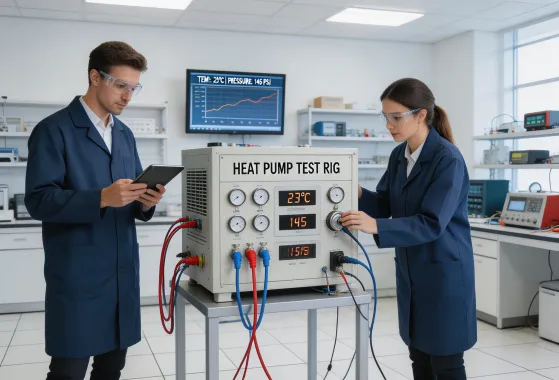
StiebelHeat operates dedicated research and development facilities staffed by over 120 engineers specializing in thermodynamics, compressor technology, control systems, and refrigerant chemistry. Our testing laboratories include full-scale calorimeter rooms, environmental simulation chambers, and long-duration reliability test rigs.
Collaboration with university research programs and participation in industry standards development (ASHRAE, Eurovent, IEC) ensures our engineering direction is informed by the latest scientific evidence and aligned with emerging regulatory frameworks.
Key development milestones guiding our product evolution.
Market introduction of propane-based commercial heat pump series with integrated safety systems and leak detection.
Cloud-based analytics platform deployment with machine learning fault prediction across connected heat pump fleet.
Pilot installations of 90-degree supply temperature heat pump systems for industrial process heat applications.
Full SG Ready and OpenADR integration across product range, enabling demand-response participation in all major markets.
The global shift away from high-GWP HFCs presents engineers with a genuine choice between two viable pathways. Understanding the trade-offs is essential for long-term investment decisions.
Natural refrigerants offer GWP values below 5 and zero ozone depletion potential. R-290 (propane, GWP=3) delivers strong COP performance in air-source heat pumps, while R-744 (CO2) excels in hot water and transcritical applications. R-717 (ammonia) remains the standard for large industrial systems above 500 kW.
Considerations: R-290 is flammable (A3 classification per ISO 817), requiring charge limits under EN 378 and dedicated safety systems including leak detectors and ventilation. R-744 transcritical systems operate at pressures above 90 bar, demanding specialized components and trained service technicians. R-717 toxicity restricts its use in occupied spaces.
HFO refrigerants provide GWP values below 10 with near-drop-in compatibility for existing R-410A and R-134a infrastructure. R-1234ze(E) (GWP=7) is gaining traction in medium-temperature chillers and heat pumps, while R-454B (GWP=466) serves as an R-410A replacement with moderate GWP reduction.
Considerations: HFOs decompose into trifluoroacetic acid (TFA) in the atmosphere, raising environmental persistence concerns under ongoing regulatory review. Patent restrictions from chemical manufacturers affect pricing and supply chain independence. Long-term regulatory status beyond 2030 remains uncertain as GWP thresholds continue to tighten under the revised EU F-Gas Regulation (2024/573).
StiebelHeat develops platforms for both pathways. Our engineering recommendation depends on application type, charge size constraints, local safety codes, and the building's risk profile. We provide detailed refrigerant selection reports as part of our system design service.
Transparent engineering means acknowledging where current technology has limits.
Air-source heat pump COP degrades below -15 degrees Celsius ambient. At -20 degrees Celsius, supplementary heating (electric or boiler backup) is typically required to maintain rated output. Ground-source systems mitigate this limitation but require adequate land area for borehole or horizontal loop installation.
Current commercial heat pump platforms deliver supply temperatures up to 65 degrees Celsius efficiently (COP above 2.5). Our high-temperature development targets 90 degrees Celsius, but pilot-stage systems at this temperature achieve COP values of 1.8-2.2, narrowing the efficiency advantage over condensing gas boilers. Full commercial availability is projected for 2027.
EN 378 restricts R-290 charge to approximately 1.5 kg in occupied spaces for A3 refrigerants, limiting single-unit cooling capacity to roughly 25-30 kW. Larger installations require multiple parallel units with individual leak detection circuits, increasing initial system cost by 15-25% compared to equivalent R-410A systems.
We collaborate with facility owners, consulting engineers, and research institutions on pilot projects that push the boundaries of heat pump application. Contact us to discuss joint development opportunities.
Discuss a Collaboration