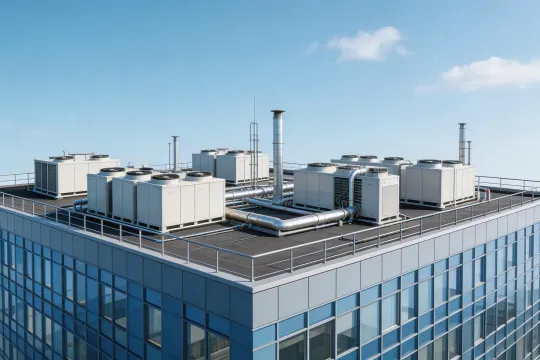
Office Complexes & Hospitality
Large-scale air-source and water-source heat pump systems rated from 50 kW to 2 MW heating capacity, designed for commercial HVAC applications. Our systems meet ASHRAE 90.1 energy standards and achieve seasonal COP values of 3.2-4.8 depending on climate zone and heat source configuration. BMS integration via BACnet and Modbus protocols enables centralized monitoring of compressor status, supply/return temperatures, and energy metering. Suitable for new construction, deep retrofits, and hybrid heating configurations that combine heat pumps with existing boiler infrastructure.
Discuss Your Project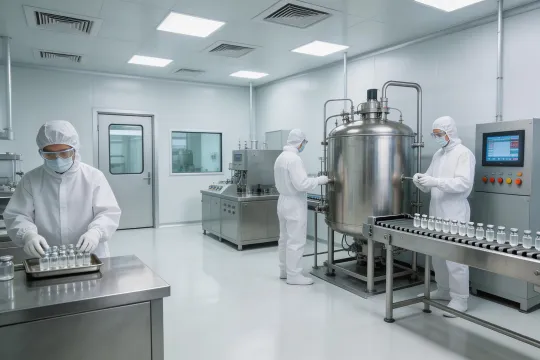
Pharmaceutical & Life Sciences
Precision heating and temperature control for cleanrooms (ISO Class 5-8), laboratories, and GMP-regulated production environments. Our heat pump systems deliver stable supply temperatures within +/- 0.5 degrees Celsius tolerance with rapid response to load transients, supporting pharmaceutical manufacturing, vaccine cold chain storage (2-8 degrees Celsius), and laboratory environments where thermal drift compromises assay accuracy.
Discuss Your Project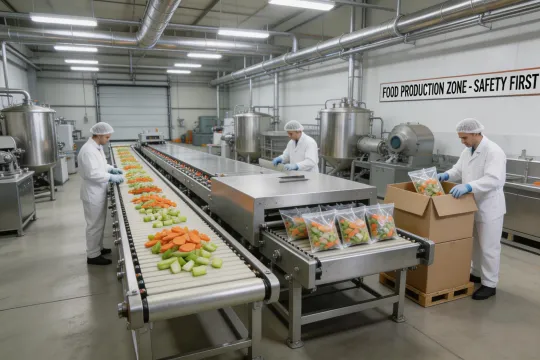
Food Processing & Production
Process hot water, pasteurization heating, and sanitation systems designed for HACCP-compatible food processing environments. Heat pump technology recovers waste heat from refrigeration systems to generate process hot water, reducing both energy costs and the facility's carbon footprint.
Discuss Your Project
Data Center Heat Recovery
High-efficiency heat recovery systems that capture thermal energy from server cooling loops and redistribute it for building heating or district heating networks. Our solutions transform data center waste heat from a disposal problem into a valuable energy resource, improving facility energy metrics.
Discuss Your Project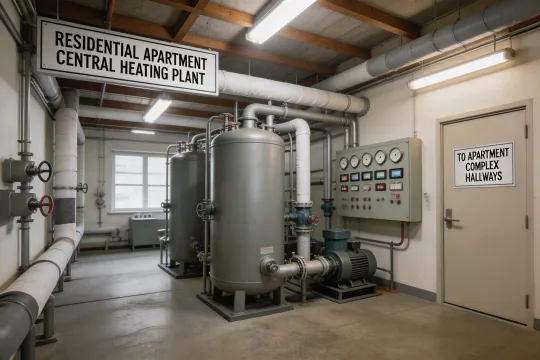
Multi-Family & District Heating
Central heat pump plants for multi-family residential developments and district heating networks. Our cascade and modular heat pump systems scale from single buildings to neighborhood-level thermal networks, supporting net-zero energy building standards and renewable heating mandates.
Discuss Your Project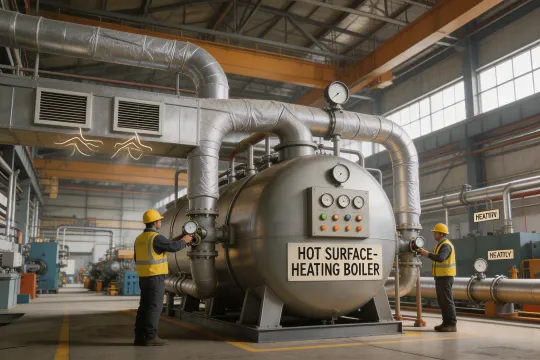
Industrial Process Heat
High-temperature heat pump systems targeting supply temperatures up to 90 degrees Celsius for industrial process heating applications. Current systems deliver 65 degrees Celsius supply at COP 2.8-3.2, with 90 degrees Celsius platforms in pilot phase (COP 1.8-2.2). Suitable for textile processing, chemical manufacturing wash circuits, and food-grade pasteurization where fossil fuel boiler replacement with heat pump technology reduces both emissions and long-term energy costs. Note: applications requiring supply temperatures above 90 degrees Celsius currently remain outside the heat pump operating envelope and require conventional boiler or steam solutions.
Discuss Your Project